Monday, December 26, 2011

Researching the Lafayette Escadrille

Weston Birch "Bert" Hall

In working on my upcoming book on Bert Hall, I have been drawn into the researching the Lafayette Escadrille.  It has been fascinating and enlightening.  At the same time, I find myself being drawn into doing my job as a historian – that is trying to arrive at the truth.  In some cases this may require the rattling of a myth or two. 

It is important to note that Bert’s involvement with WWI aviation was only one part of his incredible life as a soldier of fortune.  My book will cover his war experience but will also tell the whole story of Bert’s fantastic life; good and bad.  From Chinese aviation, to the motion picture industry, Bert Hall led the kind of life that many only dream of.  Bert’s saga cut its teeth when he was in the Lafayette Escadrille – so it is something I have had to immerse myself in.   

For those of you that don’t know the Lafayette Escadrille was a squadron of young Americans volunteers that were flying for France in WWI.  They were fighting the Germans a full two years (in aviation) before America declared war.  Many of her early members were members of the French Foreign Legion…Americans that had been in the fight since 1914.  These men (and those of the larger Lafayette Flying Corps) went on to be the foundation of the American Air Service.   The unit and the men that flew for her were known by almost everyone in the United States at one time.  The unit was a household name for years.  Their exploits made almost every newspaper in the country.  America’s brightest and best young men, using the latest technology (aircraft) to fight a war we were still unwilling as a people to commit to  - it was wonderful press. 

The original members were referred to as the, “Valiant 38.”  Most were from ivy-league colleges.  They were, in most cases, rich kids.  Bert Hall didn’t fit that mold.  He was older than most of these kids.  He never attended college.  Bert was not in the war for glory or honor, he was in it for himself and to hopefully make a buck.  Bert didn’t come from the same mold as these men.  But they too were imperfect.   

My research efforts last week took me to the Paul Rockwell collection at Washington and Lee University.  Paul Rockwell was the historian of the Escadrille.  His brother was one of the first American aviators killed in combat in the unit.  Paul Rockwell dedicated his life to embellishing the history of the Escadrille and the memory of his brother Kiffin.   Sometimes that dedication bordered on obsession.  I think we are all richer for the work he did, but it must be viewed from a historian’s skeptical perspective. 

In going through the fourteen boxes of material and photographs it became clear quickly that Paul Rockwell had a strong dislike of Bert Hall.  Some of that was probably earned – no, definitely earned.  Rockwell carefully sculpted the history of the unit with historians that worked with him on their books and articles about the unit.  I could see clearly how he excised Bert from the Lafayette Flying Corps and Lafayette Escadrille Memorial in France.  He went so far as to control images used in some books, cropping Bert out of the images (and hopefully out of the history of the unit.)  Paul Rockwell worked quite hard to script out the image that the public would have of the escadrille, even if that meant he had to alter the truth. 

A prime example of this is Paul Rockwell’s campaign against the movie, Lafayette Escadrille.  There was a full box of material in the collection at Washington and Lee of his letter writing smear campaign against this 1950’s film.  He wrote Time, Newsweek, The New York Times; anyone that would listen.  He rallied the survivors of the unit and in some cases their families into his campaign.  He used phrases like, “sullying the memories of the honored dead,” to drill home his points.  Some of his complaints were valid.  The movie was a Hollywood version of history – which meant it was inaccurate.  No shock there. 

Some of what he went off about represents how he tried to change the history of the unit.  “This movie portrays the members of the unit drinking alcohol.  The lead character meets a charming prostitute in a brothel and falls in love with her.  Members of this unit did not frequent brothels nor were they given to drink.”  Really?  I have come across accounts that Bert Hall and Raoul Lufbery were both known to frequent brothels.  Almost all of the members of the Escadrille drank – there are photos of them drinking.  In his later years Paul Rockwell seemed obsessed with making the unit into something that it wasn’t.   He was not being a good historian but instead was corrupting history. 

In going over the vast number of letters in the Rockwell collection, I began to see a more rounded story about Bert Hall and of the Escadrille as a whole.   I found that using the letters of the men from the period gave me a better grip on the unit.  I thought I was going to be writing about Bert Hall’s life.  Little did I realize how I would be drawn into the Escadrille and its own starry history.  For WWI buffs out there, I hope you find my new research findings of interest.  It does not alter the history of the unit, but brings clarity to this famous group of men.  For those of you not familiar with the Lafayette Escadrille, I think you’ll find my perspective, tied closely to Bert Hall, to be intriguing. 

More in future blogs…I promise. 

Saturday, December 17, 2011

Two Exciting New/Old Projects

I am currently writing multiple books – that’s the nature of being an author.  I’m going to go to Washington and Lee University this week to do some research on my Bert Hall biography.  I’m also doing some research on my next true crime book project on the murder of Daisy Zick.  I find the diversity of projects and their various stages in the lifecycle of a book being written gives me the flexibility I love about being a writer. 

Two of my projects are coming to the surface in the next month or so and both are incredibly neat.  That’s the focus of this week’s blog. 

First is Virginia Creeper.  This project was started by me years ago.  It is a horror/paranormal story – a new genre’ for me.  The story is set in Fauquier and Culpeper Virginia where I live and is written, for the most part, first person.   There’s a reason I chose to write the book this way…one that becomes clear as you read it. 

I’m publishing Virginia Creeper with Hydra Publishing.  My agent shopped this book around about 10 years ago.  We got some serious nibbles from some major publishers, so I kept working on it.  Usually I don’t keep working on a book until I have a contract in-hand but the nibbles we got were very promising.  They all fizzled though and with time and eventually my agent gave up.  Every year or two I would dust off the manuscript, revisit the story, write a little more, and see if there was any interest out there.  I discovered Hydra Publishing through a friend and they were excited about the prospects of doing Creeper.  From what I saw of their offerings and plans, the more I was looking forward to working with them.  They are the kind of start-up publisher that I think is going to go places in the next few years.  (I will write at some time about how the publishing industry is in complete upheaval.)   

For me this project was strange because I already had 78,000 words done by the time I had a publisher lined up.  So over this Christmas holiday I will be wrapping up the conclusion to the book and putting some polish on the older chapters.  It is a little strange to leap back into this book so close to the end.  I am also a little surprised at how my writing style has evolved over time.  I have worked on a lot of novels and books over the years and this project is very different.  A friend of mine read the first three chapters and told me he was nervous taking his trash out in the dark.   I think I hit the mark on this one.  Creeper is scary, frightening, and will be available this summer from Hydra Publishing. 

The second project that I am working on is Business Rules:  The Cynics Guidebook to the Corporate Overlords.  Yes, I am returning to business book writing and in a big way. 

Back in 1998 I wrote Cubicle Warfare and the book was a big hit.  I was on national TV and radio (Bill O’Reilly, Good Day New York, NPR, MSNBC, etc..) quite a bit talking about corporate culture and office politics.  I was even interviewed and featured in Fast Company magazine.   I always wanted to write a business book that would follow-up on Cubicle Warfare, but I never found the right venue. 

Business Rules is a book that will redefine business books.  It has taken me years to compile this work.  It is written to do something that most dry business books don’t do – entertain.  Oh, I know the trend in the last few years for academics to tell little stories in their leadership and management books to make the information palatable.  I sometimes find these insulting.  Business Rules is going to be written in a different format and approach.   It is written as a book that you can pick up and open to any page and start reading – or you can read it from beginning to end. 

The best part about Business Rules is that it is done.  I still need to do some editing on it, but the heavy-lifting in terms of the writing is complete.  I will put more in my blog on this book as it comes closer to a publishing date.   This book is going to generate a lot of buzz, so stay tuned! 

Horror – business – wow, this is going to be a Christmas to remember!

Sunday, December 11, 2011

Cover For Secret Witness is Done!

When you write a book there are couple of truly joyous moments tied to the process.  One is when you finish the book.  It’s the kind of moment you tend to enjoy all alone – but it is great.  There’s when you see the final edit (blue line) copy of the book for your last pass through it.  At that point months have passed and it’s like reading a new book all over again.  When you see your book for the first time in a bookstore is another fantastic moment.   Then there’s those moments that people contact you and say, “your book really touched me.”  These are some of the fun and private parts of being an author – that sense of accomplishment. 

Another one of the cool moments you get to experience as an author is when the art/production department shoots you over the cover for your book.   This week, the University of Michigan Press sent me the early cut of the cover for my upcoming book Secret Witness.  Here it is!

Personally, I love it.  I like the “true crime” font used – very 1960s’ which was pleasing since the book is about a crime in the 1960s’.  The address you see at the top and blending into the title is from the poison pills sent to the victim, Nola Puyear, which proved instrumental in catching her murderer, Enoch Chism.  I like how the words “Marshall Mich” blend into the text.  Seeing the scrawled address brings back memories of the evidence in the case, of a devious plot to kill an innocent women that took months to accomplish.  Nola’s death, on Michigan Avenue, by a bomb blast, tore at the heart of hometown Marshall’s innocence.   All of that came back to me.   

Seeing the cover it suddenly hit me; the book is going to be out in a few months.  The release date is now at the end of April, 2012.   Seeing the cover tells me that the edit copy of the book is going to be coming soon for my final read and approval too. 

Wow, what a journey. 

I am from the Battle Creek/Marshall area – my family is Marshall-based.  I was raised on Louie’s donuts and still have fond memories of the few times a year we ate at Win Schuler's.  I go back a few times a year, eat at Roma’s and the Hi-Lite, watch the Brooks fountain at night, and think back to the Marshall of my youth. 

Writing a book about one of Calhoun County’s most infamous crimes has been a real treat for me.  It is a chance to connect back to the Marshall of my childhood, back to 1967.  Oddly enough, not a lot has changed.  That is one of Marshall’s charms, it is a city that is almost suspended in time.  Like I say in the book, the clock stopped in the 1950’s in Marshall and never moved forward. 

Seeing the cover also tells me that I have to begin the task of setting up some book tour events.  With my daughter getting married in May, that means planning for things sometime in June.  I have a long list of contacts and places that I need to see if I can coordinate and arrange.  I enjoy the public appearances—it is a chance to go beyond the book and tell more of the story.  I also get to meet some interesting people along the way. 

Despite the sensitivities to the families involved with the events in 1967, I will be doing some events in Michigan and Virginia to promote the book.  Promotion of a books is a necessary and fundamental part of being a writer these days.  For those of you that live there, follow my blog and hopefully we can connect. If you are in a book club, I love doing virtual sessions where you can ask the author questions…so keep that in mind.

The inevitable question I get right about now is, “can I order the book now?”  Not quite yet – orders will start a few weeks before April.  I don’t sell personally sell copies of my books.  You need to get them from your local bookstore or online from the University of Michigan Press or whatever your preferred online source (i.e. Amazon.com).  Watch my blog – you’ll see updates as the book release gets closer and I firm up some book signing and speaking events.

Monday, December 5, 2011

A Writer's Life - My Favorite Reality TV Shows

I don’t watch a lot of television.  Oh, it’s on, in the background, but I rarely sit down for more than 2-3 hours a week and actually watch TV.  I would say it’s because there’s nothing good on, and that’s part of it.  Frankly, I simply don’t have time.  Managing two careers, something has to give. 

As an author/historian, inspiration comes from some pretty strange places.  Certainly reality TV qualifies as a strange source. 

I do enjoy some reality television – not a lot, but some.  The first season of Survivor was good, but after seeing Richard wander around naked, I more or less dumped that show.  For a while I tracked Donald Trump’s reality show, The Apprentice.  Then I realized that none of these people were over 40 years old and that most had been selected for the fact that they were highly dysfunctional and confrontational.  I must be getting old, but it seemed like they were getting a lot of “kids” for the show rather than some seasoned professionals that might be looking for new career directions.  The Apprentice was entertaining, for a few weeks, then I got bored.  It finally dawned on me, why would anyone want to work for Donald Trump?  

There are some reality shows I like though.  I thought my readers might be interested in what I watch and why I like them.   

American Pickers (The History Channel).  The concept here is very simple, two guys traveling around the country buying rusty relics and “farm-fresh” antiques and reselling them.  Alright, I know a lot of this is staged, it has to be.  Let’s face it, the camera crews are often filming some of this before the guys show up, but it is neat to watch.  Why?  Well, my grandfather, Archie Pardoe, was a Picker. I spent my weekends hitting garage sales or traveling the back roads of Western Michigan buying some of the same stuff that Mike and Frank do.  Many days were spent at auctions.  I can’t tell you the number of times I’ve carried dirty furniture out of some half-collapsed barn after one of my grandfather’s purchases.   My grandfather was the master of the deal.  He could purchase a truck-load of antiques and sell half of them before we got home (never telling Grandma that he had!)  I’ve spent a lot of time crawling around barns, basements, attics and garages pulling out some real treasures. 


With my grandfather it was all about the art of the deal – negotiating with people.  I guess that is one of the things I love about the show is the bartering.  Also, I like this show because it shows a side of American antiquing that is out there and is entertaining.  A part of me wants to go with Mike and Frank once, just for grins.  I learned a lot about history being exposed to antiques my entire life…something I turned into a profession as a history author.  I don't miss Pickers every week, and neither should you. 

Cops (Fox) and (occasionally) Campus PD (G4).  Cops is and remains a great show and Campus PD is funny only because drunken college coeds are a riot to watch.  My wife Cyndi and I like Cops because we’ve learned some key lessons in life from the show:
1.  You are usually guilty of something if you are apprehended without a shirt on.  I haven’t crunched the statistics on this but trust me, if you are shirtless and on the streets after 11pm, chances are pretty damn good you are guilty of something. 
2.  If you have a tattoo, you are more likely to have committed a crime.  Like the shirt-thing, I realize this is profiling.  I’m comfortable with that. 
3.  “Those drugs aren’t mine!” Let’s be honest, those drugs are always yours.  Rarely in the history of Cops does someone say, “that bag of drugs under the driver’s seat belongs to me officer.” 
4.  When a policeman asks if you have any outstanding warrants and you respond, “I don’t think so,” you are lying. 
5.  Tasers = fun!  I am almost ashamed to say I love it when a loud-mouthed wife-beater is tased into a whimper pile of quaking agony.  I used the word, “almost…”
6.  People are morons.  I saw one woman (okay, a hooker) grab a police officer to complain that she gave a guy $20 for crack and he gave her plaster dust instead – she was demanding the officer go and get her a refund or the drugs.  There are at least two things wrong with that sentence, possibly more.  You figure it out.  These idiots are out there wandering our streets, and apparently they vote. 
7.  You can outrun a cop – but not a police dog.  I encourage you to try because it makes for great television for those of us that watch the show. 
8.  You can’t hide under a mobile home at 3:30am after allegedly beating your 600 lb wife and profess complete innocence.  If you are hiding, there’s usually a pretty good reason you’re hiding.  It’s call guilt.  Innocent people are generally not under a mobile home in the middle of a summer night. 

Campus PD is fun because college students are so damned arrogant – they argue with police who have no sense of humor in such matters.  No wonder a lot of kids can’t get jobs when they graduate.  Yes, the economy is bad, but the arrogance-level of the students produced is amazing. 

Gold Rush (Discovery)   On this show, a bunch of out-of-work guys go up to Alaska and attempt to find gold.  While the premise is simple the complexity of what they are trying to do, and their lack of skill (and often common sense) make the show entertaining.  One of the reasons I love this show because it is the essence of the American dream.  These guys do work hard (not smart) to try and strike it rich.  

Most of these guys have to go to Alaska because there’s no way they could work or play well with others in the lower 48.  The personalities make the show worth spending time with.  The argue, get physical, throw things – in other words there’s a reason they were unemployed in the first place. 

The first season the guys didn’t get rich.  I’m frankly surprised they all survived.  This season their interpersonal conflicts and sheer stupidity are off-set by the fact that they still stand a chance of finding a lot of gold.  I can’t pass this show up.   

Sons of Guns (Discovery)  This is about a custom weapons manufacturing company Red Jacket.  These guys modify weapons and build weapons from scratch.  The owner (Will) can be a redneck one minute and a 10 year old kid the next.  His daughter Stephanie runs the business itself, often playing the role of adult to her father who just wants to blow things up.  The guys make machineguns, rocket-launchers, flamethrowers and everything in-between.   I would love to tell you what the appeal of this show is, but I can’t.  It’s just awesome.  If I had any skill mechanically, I’d love to work at Red Jacket.  There’s no real risk of that happening. 

Storage Wars (A&E) and Auction Hunters (Spike).  The concept here is simple:  People bid on abandoned storage units without knowing what is there.  Then when the sale is done, they root through the garbage to sometimes find some amazing collectables and stuff.  I’m not stupid, I don’t buy into the concept that these things aren’t staged for the audience just a little.  I hate Dave Hester and think Barry is one stroke away from a nursing home.  Brandi irritates me and frankly I believe her and Jerrod deserve each other.  There, I said it.  God I’m pathetic…I’m actually paying attention to this show and the actors/participants.

At the same time this show is a lot like gambling where at least you stand a chance of winning (as opposed to a casino.)  Seeing the kind of junk people store (and abandon) is fun.  I’m amazed at the items that get pulled out of these storage units. 

Antiques Roadshow (PBS) and Pawn Stars (The History Channel).  I’ll admit it, I watch PBS – so shoot me.  Not only was my grandfather a Picker but my father owned an antique mall.  I always get a kick out of people that bring in junk and find out that it is worth serious cash.  Likewise, I have to admit, I enjoy it when they think they have something worth a fortune only to find that it is worthless crap. 

These shows are perfect to have on when I’m writing because I’m only interested in a few of the articles that are shown.  I can work away ignoring the show until something neat comes up.

The roadshow used to drive my dad up the walls.  People would see something on the roadshow and assume they owned the same thing – and that it was worth the same amount of money.  People would show up and say, “give me $10,000.00 for this – that’s what they said it was worth on the roadshow.”  It added five years to his age.  He usually invited them to go track down the appraiser on the show and get him/her to cut them a check.   

Pawn Stars adds a little character to it because of the guys working there. Let’s face it, the Old Man is a riot.  ChumLee is so mentally slow, it’s a miracle that he finds his way to work every day.  Corey is lazy and somewhat stupid (the guy bought a hot air balloon for God’s sake.)  I enjoy some of the incredible artifacts that come in, and love I when they have Chum test out the weapons to see if they’ll explode. 

I was going to list History Detectives on PBS as well, but I am not sure if that qualifies as reality TV.  I have done some research for the producers of the show so obviously I am biased.  So for now, it’s not on the list. 

So, feel free to post up your favorite reality shows below.  If you list the Jersey Shore as a favorite, be prepared to defend yourself from the inevitable abuse however.  

Saturday, November 19, 2011

BattleTech Flashbacks

It dawned on me a few years ago that I’ve been writing material for BattleTech and MechWarrior for a long time – over a quarter of a century.  One, it made me feel old.  Two, it stirred up some memories that were fanned even further at GenCon this year.  (I really wanted to sit down and play the board game but I wasn’t able to.) 

For those of you that don’t know, BattleTech is a robust science fiction universe that has millions of printed words supporting it.  It has been PC/Xbox/Sega games, board games, toys, a cartoon series, comic books, novels, and, well, just about everything else.  For over a quarter of a century the BattleTech universe has grown and expanded.  It is huge, with thousands of followers.  It is something I’m proud to have contributed to (in my own little ways). 

When I got involved in BattleTech it was by accident.  My last semester of college I wrote a scenario set for the Star Trek RPG from FASA.  I reached out to them at the end of the semester and Ross Babcock said, “I love it.  But before we publish it, would you like to write for BattleTech?”  I had no idea what it was.  Ross sent me a copy of Battledroids (the name of the game before it became BattleTech) and some material on the universe. 

I got hooked quickly.

BattleTech was more simple in those days.  You defended a planet with a company of ‘Mech.  New ‘Mechs weren’t manufactured, you had to salvage your damaged gear to keep functional.  It was big robotic fighting machines slamming it out with lasers and missiles.  Hell, I admit it, I loved it.  The fact that you could construct a ‘Mech made the game variable, more interesting than the usual board game fare

Ross sent me copies of the rough sketches of some of the ‘Mechs for the original (first) Technical Readout and said, “Here…write up some descriptions of these.”  He said that I was writing along with a handful of other authors and whoever did the best, would get more to do.  We got paid a whopping $50 per ‘Mech, which seemed fantastic.  I mean seriously, I was getting paid to do this?  (I still have those original copies in a binder along with the original dot-matrix printer version of universe guide.)   

I must have done pretty well because I was getting BattleTech work two years before the Star Trek scenario I wrote (The Strider Incident) was finally released.  I wrote anything and everything I could for BattleTech.  The book opportunities kept coming.  Ross handed me a three sentence description for a mercenary unit called Snord’s Irregulars.  With that kernel of thought, I cranked out two supplements. I asked once where the name Cranston Snord came from and the answer I got was that it was from an old BC cartoon, the punchline to the joke of “Who is buried in Grant’s Tomb.”  Back in those days, a good idea got jotted down and shot out to those of us writing and we turned it into a product. 

The universe changed with the 4th Succession War.  Suddenly there were new ‘Mechs, regiments of troops (where did those come from?) and deep politics.  Keeping track of the universe, for years, was every writer’s responsibility.  There was no database to go to for continuity checking.  Every year the product became more complicated, more complex, more challenging.  I loved it!

Every year I went to Sam Lewis for what I lovingly called, “My annual grovel for a novel.”  I would bring three to five ideas and pitch them.  For two years I was sent packing with, “maybe next year.”  One year I met Sam at Gen Con and pitched five ideas.  The last one I had written the night before leaving for Milwaukee, a hurriedly scribbled idea that I had put no real thought to.  Sam chucked the first four ideas but latched onto the last one – Highlander Gambit.  He loved the idea of a Death Commando coming home to the Northwind Highlanders.  I remember thinking, “wow, I sold a novel idea – and I really have no idea what I am going to write…holy crap!” Somehow, in a matter of a few hours, I had a detailed chapter-by-chapter summary done.  The story, the characters…they all seemed to just come to life.  As a person that dabbles in playing the bagpipes, I simply loved writing about mercenaries that wore kilts.   

The novels are beyond fun to write.  It’s not just the stories, the political intrigue, and the battles.  It is about characters.  I still write books that I enjoy reading, though I admit I haven’t cracked one of my own books in years.  They are still stories that I think hit the mark.  With more than 12 under my belt (if you check the fine print in Star Lord, you will find that I did the rewrite on that novel – and I could do a whole blog entry on that bad experience alone, trust me), I would do another one in a heartbeat. 

I was asked by a fan this year at the Catalyst Game Labs booth, “which is your favorite novel you wrote?”  Wow.  That is tough to answer because I like all of my novels for different reasons.  I can narrow it to two.  First, from the original series of novels, Exodus Road.  The Smoke Jaguar character of Trent…turning traitor to the Clans was neat.  I mean seriously, the main character is someone you like but he is a traitor!  Trent was complex in many respects.  Exodus Road is the story of someone that put honor above politics, even if that meant killing the very thing he loved. Trent became the instrument that spelled the end of the Smoke Jaguars.  Imagine that kind of emotional burden.   

Second, from the Dark Age novels, Surrender Your Dreams tops my list as a favorite.  Surrender should have been a dud of a book.  I was told, “give us three stories of Knights of the Republic trapped outside of Fortress Republic.”  I toyed with doing just that, three separate little novellas.  That seemed lame and I figured the readers would rebel against that approach.  Then I thought, “why not stitch the stories together?” I wanted some ties back to the original series of novels.  Since I precipitated the demise of the Smoke Jaguars in Exodus Road, I thought, “what if we told the story of what happened to the survivors of that Clan – what they became.”  The Fidelis were born.  No longer the Jags of old, they were something else, something cooler. 

I was watching Pulp Fiction and I got the idea of jumbling the order of the chapters.  A lot of thought went into that.  Some readers hated it.  I didn’t and wouldn’t change a thing.  The book has everything, the ghost of The Master, Redburn, and even Devlin Stone (albeit in a message.)  I know some people didn’t like Surrender Your Dreams, but I thought it was neat and stand solidly behind it. 

I don’t get the play BattleTech too often any more.  My kids and my friend and his kids played the Wizkids game MechWarrior.  I know purists swear long and hard about that rendition of the game, but I liked it…and so did the kids.  We waged some massive battles, raining artillery everywhere, letting loose with Alpha Strikes.  It was fun.  I collected the BattleTech comics and the toys too.   

Back “in the day” we used to get all of the authors together every year at GenCon for a brunch.  We would talk, brainstorm ideas, hear the latest changes in direction in the universe, get a run-down of what was in the product pipeline – that kind of stuff.  These meetings were a lot of fun.  We don’t do them anymore, but I wished we did.  Sometimes egos got stepped on but overall, these were fun to attend.  It was a chance for those of us on the inside track to talk and joke about BattleTech in a way only we could. 

I am still writing BattleTech too.  Two weeks ago I finished an installment in my series for BattleCorps continuing the story of Raul Tinker in Son of Blake.  I have a plan for this series that goes through the end of the Jihad.  When done, the installments are a novella all on their own and tell the story of the Jihad from the Word of Blake’s perspective.  I would really love to see the Wolverine Saga published as a book (Betrayal of Ideals).  BattleCorps had kept BattleTech fiction alive and well. 

As much as I harp about the good old days, there were things then that drove you nuts as a writer.  The universe got so big that you had to ask for help to keep track of all of the subtle changes - for example.  The current product leadership under Loren and Randall is, well, great.  Like myself, these guys have a love of the product and the universe and kept the classic board game brand going when everyone else saw it as dead.  BattleTech is making a resurgence, at least that is the buzz I’m hearing and witnessing.  I don’t think our best is behind us.  The best is about to come!

Sunday, November 13, 2011

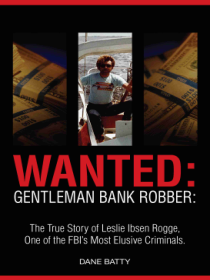
Book Review: Wanted: Gentleman Bank Robber - By Dane Batty

Dane Batty, the author of Wanted:  Gentleman Bank Robber: The true story of Leslie Ibsen Rogge, one of the FBI’s most elusive criminals, reached out to me to ask if I would do a review of his book.  I get these from time-to-time and try not to pass up the chance.  I wasn’t disappointed. 


This book is a trade paperback book from Nish Publishing Company and from what I can see, this is Dane’s first book.  Sometimes this throws up some red flags.  Adding to this, he is the nephew of the subject of the book.  My apprehension level was pretty high as you can imagine.    

Most true crime books are about murders and they have a pattern of sorts.  You start with the crime itself – usually with a scene of brutality to pull in the readers.  Then there is the search for the killer, the capture, the trial (if there is one) and the closure.  I’m not knocking this genre, I write in it myself.  The pattern is one that should be familiar to most readers of true crime.

This book is different though.  It is not about a murderer or serial killer, but a bank robber.  Batty starts out with a robbery, enough to whet our appetites, the pulls us into the story itself. 

The book is written in two voices, the author (Batty) and that of Leslie Rogge outlining his robbing lifestyle.  I was a little torn on the writing at first.  Rogge doesn’t give any context to his crimes, he tends to write what he was thinking, what he saw, and what he did.  We don’t get the usual flavor for the scenes that a polished professional writer provides.  Batty’s sections are fairly small and he misses a chance to provide some context and detail that would have enhanced the story.  That was my only disappointment with the book, and it is one I found myself moving past.    

This is the story of how a man traveled around the country (and the world) robbing banks.  He was not a violent robber.  His style was subdued and not severely threatening.  Rogge would wear a suit into the bank and carry a briefcase with a police scanner.  He would schedule a meeting with the bank manager and rob the vault quickly without a lot of panic or grandstanding. 

What the reader gets in this book is a blueprint on robbing a bank in the 1980’s and 90’s.  Rogge is not a likeable character at all.  He seems almost sociopathic, not caring about the terror he inflicted on others.  People took him in to help him when he was down and his pattern was to turn and take advantage of them, often robbing them as well.  There isn’t a hint of remorse on his part for what he did or the consequences of his activities.  My aunt and cousin work in banks that have been robbed and trust me, it does emotionally traumatize people to go through it.  Rogge commits this crime with wild abandon and seems to think it was fun.  The fact that he showed a weapon to people and threatened to turn the robbery into a homicide doesn’t seem to faze him in the least. 

Rogge’s family was under constant surveillance by the police who were hunting him down, but Rogge does not seem to care.  For him the world was a playground where he took advantage of the people and situations around him without a second thought.  At one point I put down the book and realized that he had his girlfriend and her young boy with him while he’s fleeing the FBI dragnet and continuing to rob banks.  Yet from his own words, he never seems to give that any thought. 

And yet, I couldn’t put this book down!

I wanted to hate Rogge, but found myself fascinated with his lack of guilt for his actions and the way he planned his robberies.  This book puts you in the mind of a professional bank robber, a man who did it often and got away with incredible amounts of money.  It disturbed me that people like him walked the planet…but at the same time I had to keep reading.  There was no one in the book I was championing, not a single law enforcement officer was interviewed for the book.  As much as you end up disliking Rogge, you keep reading to see just what he’ll do next. 
 
With all respect to the author, I don’t think that Rogge was a “gentleman robber.”  However reading about him exposes a character unlike any I have read about in recent years – a man devoid of care about others.  Someone could get their doctorate degree by writing a paper about the quirks of his personality.  Dane Batty’s brought us a good tale here and you should pick it up.  Wanted is not your typical true crime fare.  Despite its weaknesses, I found myself driven to finish it and I think you will too.  Pick it up and be prepared to enter a world that few of us ever see or can even comprehend – the mind of a serial bank robber.  You will never enter a bank again and not look around at the patrons and wonder what is really going on, wondering if that man sitting at the manager’s desk is actually robbing the bank.     

Go buy this book. 

Sunday, November 6, 2011

The Importance of Alternate History

I am a huge fan of Alternate History.  For those of you that don’t know; Alternate History is the genre of books where a historical event is changed.  The effect is a story where a new set of events unfold, providing the readers with a new perspective of the importance of the actual events that occurred.  You end up with stories that can be compelling…what if the Confederacy won the Civil War or if Hitler had successfully invaded Britain?

Philip K. Dick really kicked off this genre with The Man in the High Castle where Germany wins WWII.  Harry Turtledove really became the flag-bearer of the current field of writers starting with his Guns of the South, (Time-travelers equip the Confederacy with AK-47’s) and his incredible series of books that covered the South winning the Civil War, through WWI and WWII (Picture, if you will, trench warfare cutting across the United States in WWI and you get the idea).  Robert Conroy has stepped up recently as well with a number of wonderful stand-alone books set in WWII. 

The Steampunk genre is really an off-shoot of alternate history.  It provides a glimpse into a universe where advanced technology is introduced in the pre-Victorian era.  While Steampunk stands on its own, it also has strong roots with alternate history…a relationship all parties encourage.  Read Boneshaker by Cherie Priest and you will see an alternate world where zombies face zeppelins and new technology. 

I have found that some mainstream historians don’t see the value of this kind of literature.  They see it as trivial or in some way diminishing from "real" history.  I respectfully disagree.  Alternate History is most often built on hard historical study, with the changing of an instance or event to generate the story.  This kind of literature actually encourages a study of history with readers – which is something that most historians desire.  It gives us all an appreciation for how history is like a game of Jenga.  Remove the wrong part and the entire tower comes tumbling down. 

Alternate history historians like Giangreco's Hell to Pay, Operation Downfall and the Invasion of Japan, have given new context to decisions like the dropping of the atomic bomb. While some authors tell the stories of these events, we are now seeing books emerge like this where historians give us a solid tangible history of what might have occurred.  I have a pet project I have been researching along these lines as well and find this kind of research exciting.  It bridges between alternate history fans and hard-core historians.   

If you have not explored this genre, I encourage it whole-heartedly.  The stories have impact on our world today.  If you read Turtledove’s Man with an Iron Heart on the surface it is a story about the Germans fighting on after Hitler’s death, waging a guerilla war against the occupying allies. The parallels between this and the insurgency in Iraq cannot be ignored or overlooked.   Books like this force us to put current events in perspective, and in many respects that is the essence of what historical study drives to achieve. 

If nothing else, you’ll enjoy the ride!